How Passive UHF RFID Works
A passive UHF RFID tag does not require its own battery.
The RFID reader and antenna provide the energy required by the tag during the reading process. The tag uses that energy to respond with its stored electronic identification information.
The reader captures the response and passes the resulting data to software, a database or another connected system.
- UHF RFID Tag
- Reader / Antenna
- Software / System
Actual performance depends on the tag, reader, antenna, installation, operating environment and the materials surrounding the tag.
UHF – 860–960 MHz
UHF RFID operates within the 860–960 MHz frequency range.
Unlike LF RFID, which is commonly associated with relatively short-range individual identification, UHF can support both short- and longer-range identification depending on how the RFID system is designed.
This flexibility makes UHF suitable for a wide range of identification and tracking applications.
Longer-Range Identification
One of the practical characteristics of UHF RFID is its ability to provide longer reading distances than LF RFID in suitable applications.
The actual read range is not a fixed value. It can be influenced by:
the RFID tag and antenna design;
reader and antenna configuration;
reader power and settings;
tag orientation;
surrounding materials;
installation; and
operating environment.
This means that a quoted UHF reading distance should always be considered in the context of the complete RFID system rather than as a characteristic of the tag alone.
Multi-Tag Identification
A significant capability of UHF RFID is anti-collision, which allows a suitable reader to identify multiple RFID tags within its reading area.
Rather than requiring each tag to be presented individually, a UHF system can communicate with and distinguish between multiple tags during the same reading process.
This can be useful where several tagged items – or animals – need to be identified efficiently.
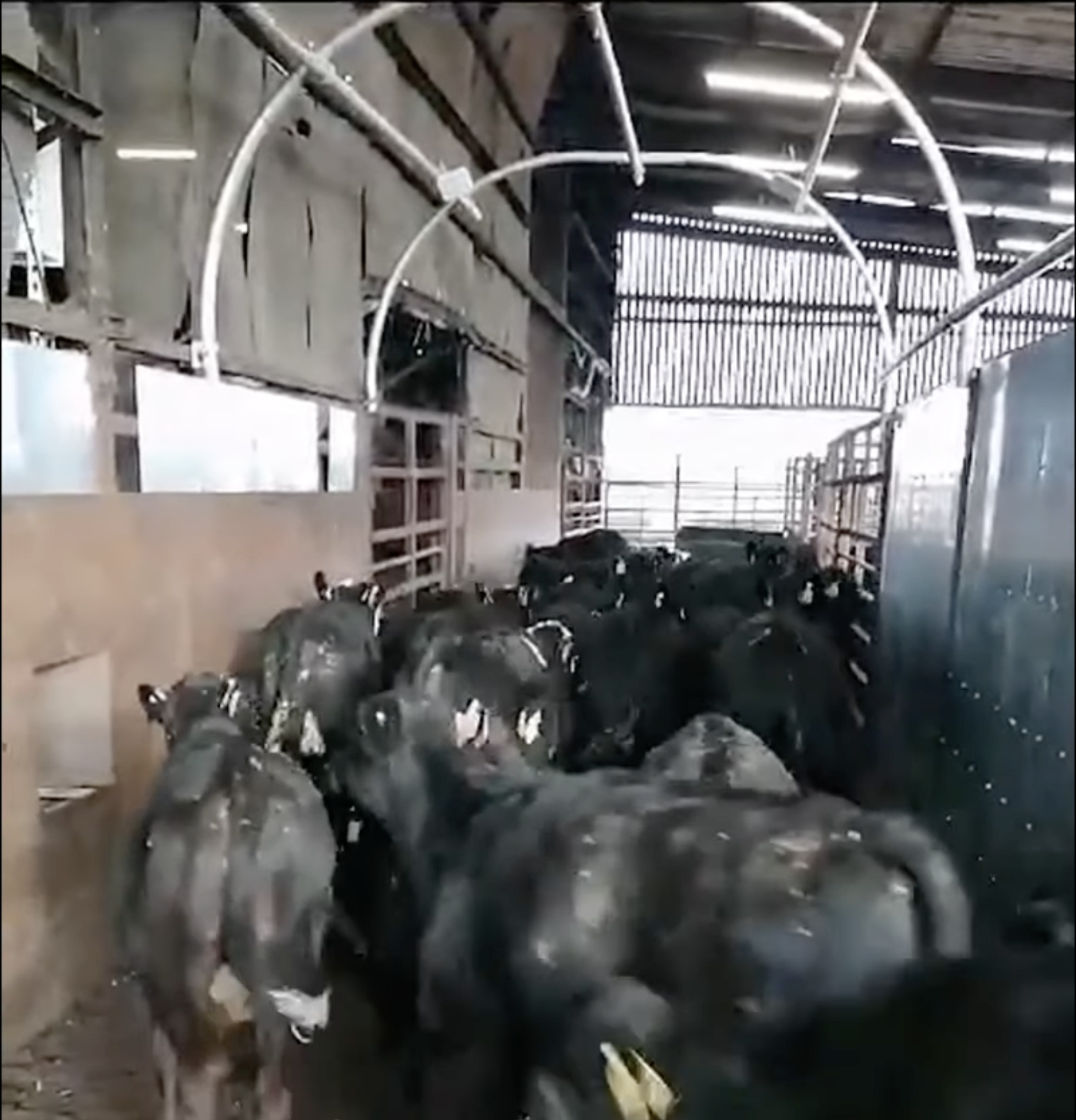 Watch on YouTube: “Watch UHF multi-tag cattle identification”
The number of tags that can be successfully identified and the speed of the process still depend on the reader, tags, antenna arrangement, environment and application.
UHF and Animal Identification
LF RFID has a long-established position within electronic animal identification, while UHF is a newer technology in this application.
UHF can offer capabilities including:
longer practical reading distances;
faster data transfer;
multi-tag identification using anti-collision;
greater separation between the reader/operator and the animal in suitable handling situations; and
potential integration with UHF systems used elsewhere in the wider supply chain.
These characteristics do not mean that UHF automatically replaces LF.
Existing infrastructure, standards, regulatory requirements and the way animals are handled all influence which technology is most appropriate.
Dual-Frequency LF/UHF Tags
Dual-frequency animal-identification tags incorporating both LF and UHF technologies are also available.
These tags can provide a practical bridge between established and developing systems by remaining compatible with existing LF identification infrastructure while also enabling the additional capabilities of UHF.
This can allow the same animal to be identified using established LF systems where required, while UHF can provide advantages such as faster data capture, multi-tag reading and greater operator separation in suitable handling environments.
In this way, dual-frequency tags can combine the established compatibility of LF with the speed and handling advantages available from modern UHF systems.
Why Standards Matter
As with other RFID technologies, UHF systems depend on agreed standards and data structures where information must be exchanged consistently between different tags, readers and systems – including across geographical borders.
An RFID tag applied or encoded in one country may need to be read and interpreted in another. International standards provide the common framework that allows compatible RFID equipment and systems to recognise and understand the same identification data consistently.
A simple example is an RFID tag used in the UK that later needs to be read in the USA. Without agreed international standards, interoperability between tags, readers and systems becomes much more difficult.
Within animal identification, UHF standards and approaches have been developing alongside the long-established LF framework.
HYKK’s current animal-identification material references UHF formats including:
ISO 6881
USDA interim
Legacy Scottish formats
The AT-01003 is designed to interpret supported UHF animal-identification formats and convert them into the Animal ID required by the receiving system.
LF and UHF in an Evolving EID Environment
LF and UHF operate at different frequencies and use different RFID technologies.
An LF-only reader cannot communicate with a UHF tag, and a UHF-only reader cannot communicate with an LF tag. Where both technologies are present, the reader infrastructure therefore needs to support the relevant frequency or frequencies.
Within animal Electronic Identification (EID), however, the issue is not simply a choice between LF and UHF. It is also about how the technology used within the industry evolves over time.
LF RFID became established because it provided a practical, standardised electronic-identification solution and, as a result, benefits from extensive existing infrastructure, standards and industry familiarity.
As UHF technology and associated standards have developed, additional capabilities have become available, including longer practical reading distances, faster data capture and multi-tag identification.
This does not mean that established LF infrastructure suddenly becomes obsolete. Technology change within an established industry is influenced by existing systems, standards, investment, regulation and operational requirements.
The important point is that the RFID technology used for EID can evolve as the needs, standards and capabilities of the industry evolve.
Start With the Requirement
UHF should be selected because its characteristics are appropriate for the application, not simply because it is a newer RFID technology.
Factors to consider include:
required reading distance;
whether one or multiple tags need to be identified;
required reading speed;
tag size and positioning;
materials and operating environment;
reader and software infrastructure;
applicable standards and approvals; and
how the resulting RFID data will be used.
Technology choices should also be reviewed over time. The RFID technology most appropriate for an application today may not remain the best choice as technologies, standards, infrastructure and application requirements evolve.
